

Why Companies Are Moving from India to Eastern Europe for Software Outsourcing
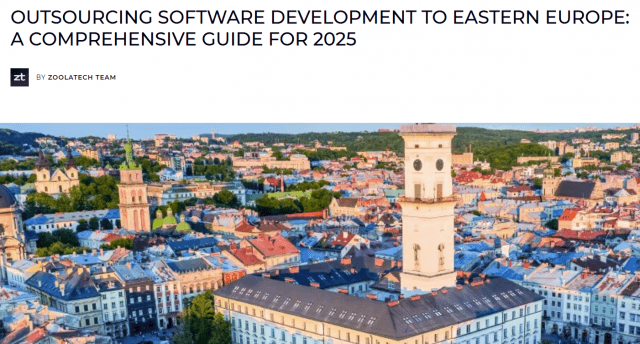
For decades, India was the go-to destination for global software outsourcing. It offered a vast talent pool, competitive rates, and a long history of serving international clients. However, in recent years, a significant shift has emerged: more and more companies from the U.S., Western Europe, and even Asia are moving their outsourcing operations from India to Eastern Europe.
This transformation isn't just a passing trend—it reflects a deeper change in global business strategy, technology requirements, and quality expectations. Let's explore the reasons behind this transition, the advantages of Eastern European markets, and why forward-looking companies are now prioritizing outsourcing software development to Eastern Europe.
1. The Evolution of Global Outsourcing
In the 1990s and early 2000s, India became the symbol of IT outsourcing. Tech giants like Infosys, Wipro, and TCS built a reputation for cost-effective software delivery. Western companies leveraged India's low labor costs to develop applications, maintain legacy systems, and handle IT support.
However, as technology advanced, the nature of outsourcing changed. Companies were no longer looking for basic coding or maintenance—they wanted strategic partners who could deliver innovation, agility, and deep expertise in complex technologies like:
-
Cloud-native architectures
-
AI and machine learning
-
Cybersecurity
-
Embedded systems and IoT
-
Fintech and eCommerce platforms
This shift demanded closer collaboration, cultural alignment, and high-quality engineering standards, which turned attention toward Eastern Europe.
2. Quality Over Quantity: The New Outsourcing Standard
While India still boasts an enormous IT workforce, many companies have faced challenges with quality control, communication gaps, and time zone alignment. Today's software projects require continuous integration, agile workflows, and rapid feedback loops, which are difficult to sustain across 10–12 hours of time difference.
By contrast, Eastern Europe offers a balance of affordability and high-quality engineering, attracting global brands that need more than just “code for hire.”
Countries like Poland, Ukraine, Romania, and the Czech Republic have developed thriving tech ecosystems that focus on innovation, craftsmanship, and long-term partnership.
3. Advantages of Eastern Europe for Software Outsourcing
3.1 Strong Technical Education and Talent Density
Eastern European countries have invested heavily in STEM education and engineering excellence. The region consistently ranks high in global programming competitions like Google Code Jam and TopCoder.
For instance:
-
Ukraine produces over 20,000 tech graduates annually.
-
Poland and Romania are among the top 10 countries worldwide for developer skills, according to HackerRank.
-
Czech Republic has one of the highest concentrations of software engineers per capita in Europe.
This means that companies outsourcing to the region gain access to deeply skilled developers who are comfortable with modern programming languages (Python, Java, Go, Rust) and frameworks (React, .NET Core, Django, Spring).
3.2 Cultural Compatibility and Communication
Cultural alignment is one of the most underrated factors in successful outsourcing. Misunderstandings, indirect communication, or differing work ethics can derail projects—even if the technical work is strong.
Eastern European professionals typically share Western business culture values: direct communication, accountability, and transparency. They also tend to speak fluent English—and often German, French, or Spanish—making collaboration much smoother than in some traditional outsourcing regions.
Moreover, companies in Western Europe enjoy nearshore collaboration, with only 1–3 hours of time difference. Even U.S.-based clients find Eastern Europe's overlap hours far more convenient than India's late-night meetings.
3.3 Geographic and Political Proximity to the West
For European businesses, proximity equals agility. Flying from London to Kraków or Bucharest takes only a couple of hours, enabling regular in-person workshops, design sprints, and team-building activities.
Eastern Europe's membership in the European Union (for many countries) ensures consistent data protection standards under GDPR, robust intellectual property laws, and reliable legal frameworks.
For U.S. companies, this also means more predictable regulation and higher data security compared to offshore destinations with weaker compliance norms.
3.4 Time Zone Benefits
In agile software development, real-time communication is essential. Developers, product managers, and QA engineers must iterate quickly through standups, sprint reviews, and code walkthroughs.
Working with teams in India or the Philippines often means asynchronous communication—feedback loops can take 24 hours or more.
By contrast, Eastern European teams can synchronize work hours with Western Europe and partially overlap with the U.S. East Coast. This allows for faster collaboration and shorter project cycles.
3.5 Competitive Cost-to-Quality Ratio
While Eastern Europe is slightly more expensive than India, it offers a far superior value proposition. Companies are willing to pay a modest premium for higher productivity, better communication, and fewer project delays.
Average software engineer rates (2025 estimates):
| Region | Average Hourly Rate (USD) | Skill/Quality Rating |
|---|---|---|
| India | $25–35 | Good for volume projects |
| Eastern Europe | $40–55 | Excellent technical depth |
| Western Europe | $70–100 | High quality, limited scalability |
| United States | $90–150 | Premium quality, high cost |
The small cost difference is easily offset by faster delivery and better long-term outcomes—making outsourcing software development to Eastern Europe a clear win for cost efficiency and quality.
4. Eastern Europe's Thriving Tech Ecosystem
Eastern Europe isn't just a destination—it's an innovation hub. Global corporations like Microsoft, Google, and Amazon have established R&D centers in Warsaw, Prague, and Kyiv. The region has also produced unicorn startups such as UiPath (Romania) and Grammarly (Ukraine), proving that local teams can build world-class products.
Tech clusters in cities like Kraków, Cluj-Napoca, Lviv, and Bratislava are now competing head-to-head with Western Europe's top innovation hubs.
This strong ecosystem fosters:
-
Active developer communities
-
Frequent tech conferences and hackathons
-
Mature agile practices
-
A startup mindset focused on creativity and innovation
5. The Rise of Boutique Engineering Partners
While large outsourcing corporations dominate India, Eastern Europe's market favors boutique and mid-sized engineering companies that offer tailored solutions, close collaboration, and long-term partnership.
One example is Zoolatech, a Ukrainian-founded company with offices across Europe and the U.S. Zoolatech focuses on custom software development, UX design, and engineering consulting, partnering with global brands in retail, fintech, and logistics.
Their approach embodies the Eastern European outsourcing model:
-
Strong technical culture
-
Direct communication with clients
-
Dedicated teams focused on outcomes, not just billable hours
This boutique model appeals to companies tired of “assembly-line” outsourcing and seeking strategic, flexible partnerships that feel like in-house collaboration.
6. Post-Pandemic Acceleration: Why the Shift Happened Faster
The COVID-19 pandemic accelerated remote collaboration worldwide. Companies realized they could work effectively with distributed teams, as long as those teams were highly autonomous, communicative, and aligned with their business goals.
During this transition, many Western firms discovered that Eastern European teams adapted faster to new workflows, tools, and communication styles than their offshore counterparts.
Their mix of European time zones, strong English, and independent problem-solving proved ideal for distributed agile delivery.
7. Challenges in Indian Outsourcing Today
To understand the shift, it's worth examining why some companies are moving away from India.
7.1 Overcrowded Market and Talent Saturation
India's IT industry is massive, employing over 4 million professionals. However, this scale has led to high employee turnover, wage inflation, and variable quality.
Top engineers often switch jobs every 12–18 months, disrupting project continuity and institutional knowledge.
7.2 Communication and Cultural Gaps
Despite strong English proficiency, clients sometimes face indirect communication or reluctance to challenge requirements—traits rooted in cultural hierarchies.
By contrast, Eastern European developers tend to question assumptions and suggest better solutions, aligning with Western expectations of transparency and critical thinking.
7.3 Infrastructure and Time Zone Limitations
Even with digital transformation, time zone mismatches remain a real obstacle for agile workflows.
Moreover, growing demand from U.S. clients has made top Indian vendors less flexible and more corporate, pushing mid-sized Western companies to explore alternatives.
8. Strategic Benefits of Outsourcing to Eastern Europe
When companies choose outsourcing software development to Eastern Europe, they gain strategic advantages that go beyond cost savings:
-
Enhanced Innovation – Teams contribute ideas, not just code.
-
Agile Collaboration – Real-time communication and rapid iteration.
-
Stronger Security & Compliance – GDPR-aligned practices and EU-level data protection.
-
Cultural Proximity – Western-style communication and shared values.
-
Stable Geopolitical Position – Many Eastern European nations are NATO and EU members.
-
Long-Term Partnerships – Teams committed to client success rather than short-term contracts.
These benefits explain why startups and Fortune 500 companies alike are moving key projects to the region.
9. Case Example: Western Retail Company's Shift to Eastern Europe
A mid-sized U.S. retail brand once outsourced its eCommerce platform development to an Indian provider. Despite low costs, it faced:
-
Missed sprint deadlines
-
Late-night coordination challenges
-
Quality inconsistencies
-
High developer turnover
After switching to an Eastern European partner—similar to firms like Zoolatech—the company saw a 40% reduction in delivery time and a notable improvement in product quality.
Teams in Kyiv and Warsaw worked collaboratively with U.S. designers, sharing overlapping work hours that allowed daily syncs and instant issue resolution.
This case is representative of many businesses realizing that “cheap” outsourcing often costs more in the long run.
10. Looking Ahead: The Future of Outsourcing
The future of global outsourcing is not about geography—it's about partnership quality. Companies are rethinking how they scale technology: through agile, innovation-driven collaboration rather than transactional labor outsourcing.
Eastern Europe is becoming the new gold standard in this evolution. The region combines technical excellence, cultural fit, and operational maturity that align perfectly with modern business demands.
As global competition intensifies, forward-thinking organizations will increasingly view outsourcing software development to Eastern Europe not as a cost-saving tactic but as a strategic investment in innovation and long-term capability building.
Final Thoughts
The movement of companies from India to Eastern Europe for software outsourcing reflects a broader global trend: the pursuit of quality, agility, and strategic alignment.
In today's digital-first world, businesses can no longer afford communication delays, unstable delivery, or inconsistent code quality. They need engineering partners who understand their market, share their values, and deliver results with speed and precision.
Eastern Europe—represented by dynamic firms like Zoolatech—offers precisely that blend of technical brilliance, cultural compatibility, and trust.
For organizations seeking to stay competitive, outsourcing software development to Eastern Europe is more than a tactical shift—it's a smart, future-ready decision.